Some companies sell products that barely break even, or even sell at a loss. These “loss leader” products even enter into pop culture, like the famous $1.50 Costco hot dog. Beyond offering a “good deal”, loss leaders are the result of deeper economic incentives and serve as a reflection of the societies in which they are found.
First off, what is a “loss leader”? These products are either sold for a loss or for little-to-no profit, but are generally considered to be priced below a single-market equilibrium price.
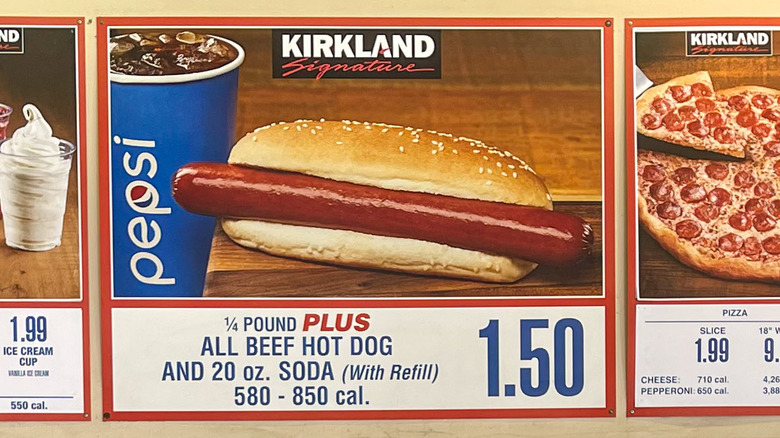
Using the $1.50 Costco hot dog (plus a free soda) as an example, suppose the price doubled to $3.00. If 200 million hot dogs were bought at $1.50, we’d expect fewer hot dogs to be sold at the higher price. If Costco’s making a small profit on each hot dog (even $0.01), as long as they still sell more than 100 million hot dogs they make more profit (e.g. 2*Price*0.51*Quantity > 1). If Costco’s losing money, a higher price and fewer hot dogs sold guarantees a higher profit (even if it might still be negative overall).
If that’s the case, why doesn’t Costco increase the price? The key assumption to break here is “single-market”; loss leaders are never sold in a vacuum. These products get customers in the door, where they will inevitably purchase some higher-margin items. Costco does this 2 ways: annual membership fees (which are nearly 100% profit) and all the other items available for purchase (the vast majority of which have positive profit margins). Although Costco might lose money in its “foot court hot dog” market, the net effect of more customers in the competitive grocery and wholesale goods industry is a higher profit overall.
Some loss leader products actually create the profitable market for other goods. Game consoles are often sold at a loss (the XBox reportedly loses $200 for each console), but once the console is sold people will need to pay for games to play on it. Markups on video games are quite substantial and switching costs are high (games are rarely interoperable across gaming platforms), so increasing your customer base in the video game market by making entry more accessible through a lower-priced game console is worth it.
Loss leaders can also be mentally accounted for as an advertising expense. Costco famously doesn’t advertise, while Walmart spends over $3B in advertising a year. For its 2023 fiscal year, Costco sold over 200M hot dog combos, Even if they lose a large amount, like $5/hot dog (and that’s a big if, Costco could be making a small profit), the ~$1B hot dog loss would still be 1/3rd the cost of advertising. Temporary loss leaders at many stores are literally advertisements: limited-time cheap prices for groceries, toilet paper, toaster ovens, or other assorted goods featured prominently on advertisements generate customer traffic, where they’ll walk right by appealing higher-margin goods.
Diving into the iconography of loss leaders reveals a lot about the societies in which they are found. Loss leaders are regional and temporal in scope: the Costco hot dog, while found outside the US, is most famously evocative of American emphasis on cheap and abundant food. The fact that it’s maintained the same price since 1985 (albeit slowly diminishing in quality over time) makes it a relic of the past for people to cherish in the present.
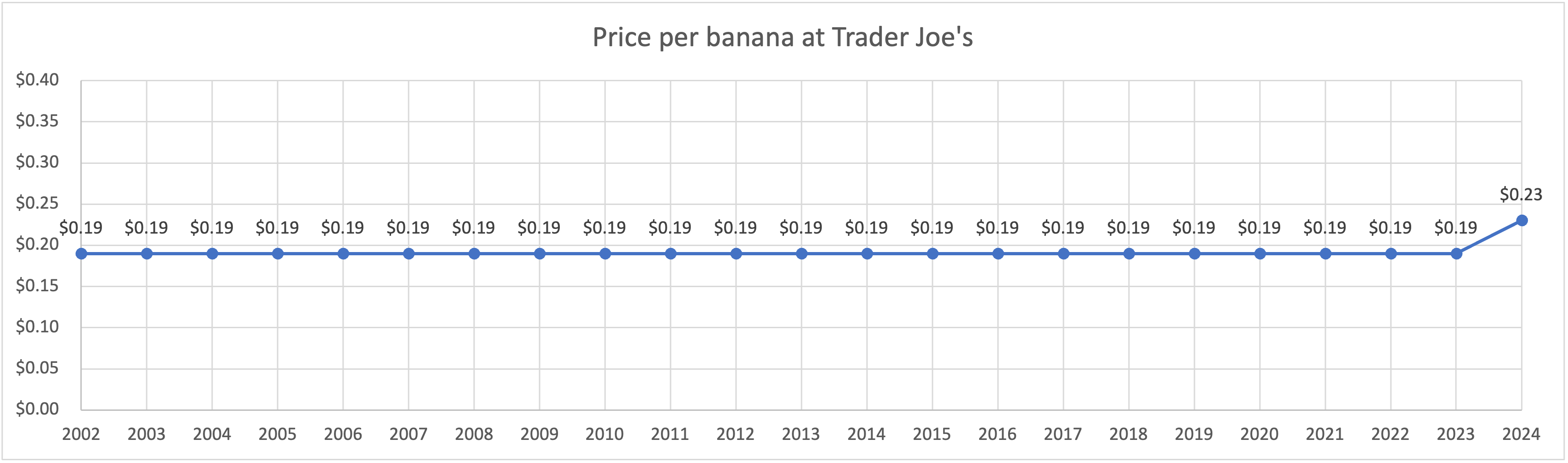
On the flipside, the $0.19 bananas at Trader Joe’s have recently increased to $0.23 after more than 20 decades of price stability. The loss of this icon serves as a reminder to consumers that these prices can’t last forever.
Other iconic prices, like gasoline for under $1/gallon, the McDonald’s $1 menu, Subway’s $5 footlong, or a plethora of $19.95 products (plus shipping and handling) have disappeared as the overall price level continues to rise. Although inflation-adjusted prices might be better for some goods, the image of these concrete prices anchor people to their past experience., with the feeling of a “good deal” lingering only in the popular imagination.
 Andrew Jabara