“I’m sorry I wrote you a long letter. I didn’t have time to write a short one.”
-Blaise Pascal [from Lettres Provinciales]
Modern society often confounds mastery and complexity. Someone who speaks in the jargon of their field, pairing big words and in-depth concepts with a silver tongue, is assumed to be brilliant. But the truth is that it’s easy to talk about complicated things by name; mastery of a subject comes when you can distill those complicated things into easy-to-understand tidbits at any level of expertise.
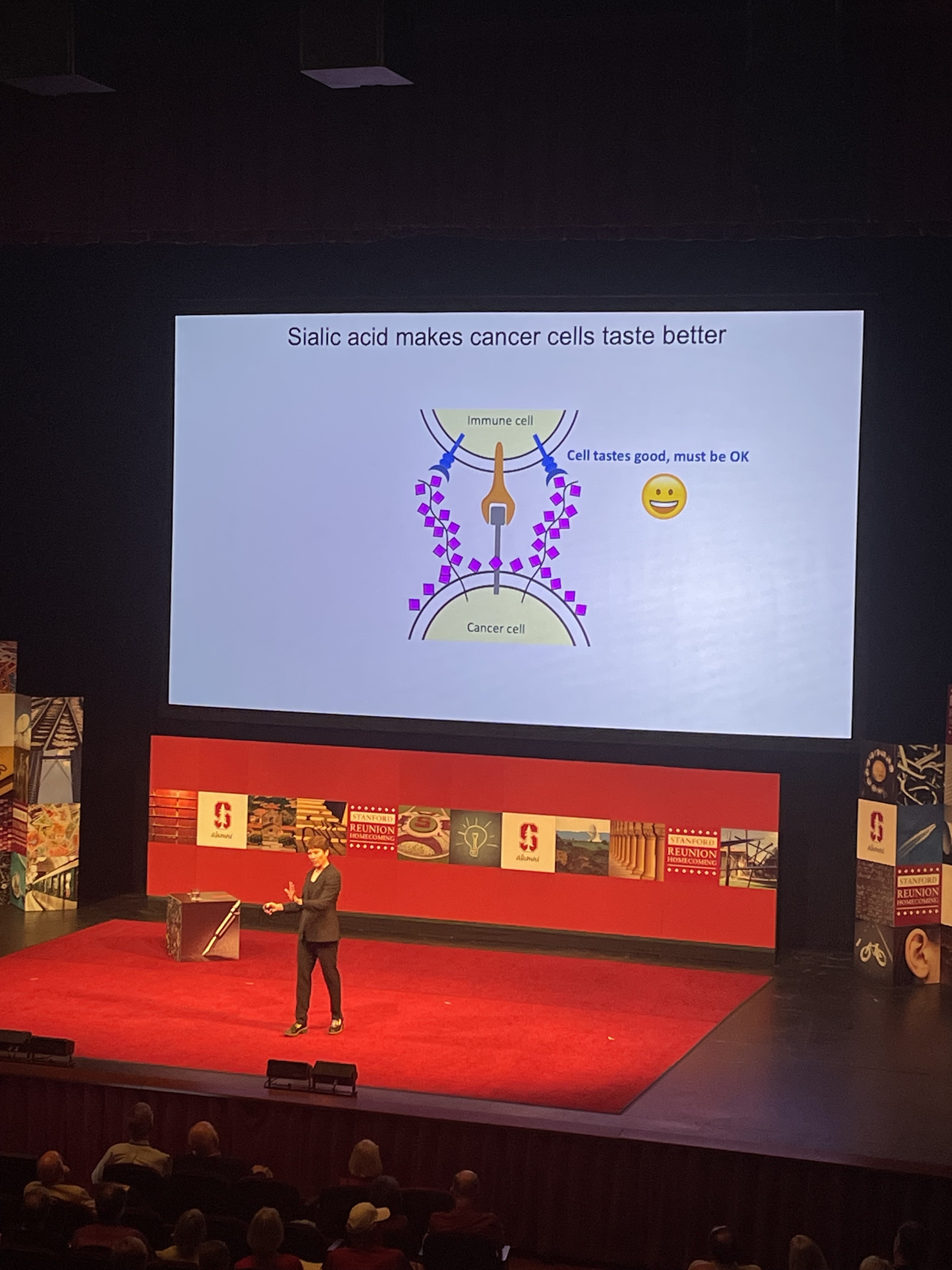
I attended a talk by Carolyn Bertozzi (winner of the 2022 Nobel Prize in Chemistry) that impressed me in its simplicity around a very complicated subject: bioorthogonal chemistry. Dr. Bertozzi’s work has advanced the field of immunotherapy (boosting immune system to treat cancer) by decades. Her example to consolidate decades of work? A peanut-covered m&m and “sweet” cells.
When Bertozzi was in school, textbooks noted that there were sugars coating a cell, and it was thought that this was like a “peanut m&m” (the sugar coating protects the cell). Bertozzi’s research uncovered a more complicated picture with strands of sugars that differ greatly between normal and cancerous cells. White blood cells that make up your immune system normally seek out and destroy cancerous cells, in part by checking whether a cell is “sweet” enough (those strands of sugars). Because of this, cancerous cells that mutate to have far more “sweet” strands of sugars are ignored by white blood cells, which allows the “sweet” cancer cells to spread.
So the old “peanut m&m” model is wrong, and the strands of sugars spinning off of cells allow white blood cells to check if they are sweet enough to be considered healthy. If we can remove or block the overly-sweet cancer cells, then the immune system can attack and clean them up like normal.
That’s a Nobel Prize-winning finding, condensed into a short and memorable example.
 Andrew Jabara